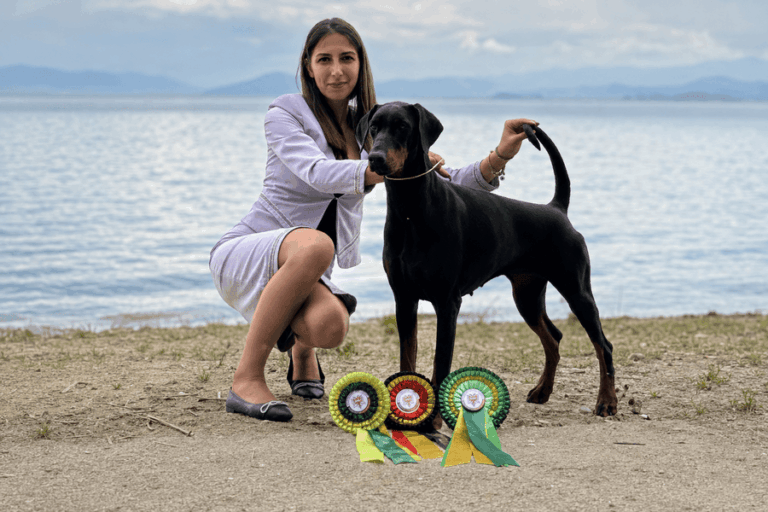
Preparing a Doberman for a show is not just about making the dog look good in front of the judge. In the ring, much more is on display—conformation, movement, confidence, rapport with the handler, body control, and overall demeanor.
A well-trained Doberman doesn’t look like it’s just winging it. It knows how to stand, how to move, how to remain steady during an inspection, and how to stay focused on its handler in an environment filled with people, dogs, noise, and tension.
At DI Valle Pica Doberman’s, show preparation is part of our overall work with the dogs. It doesn’t start the day before the show, and it’s not just about getting the dog into position. It begins with observing the dog, building trust, and gradually working on behavior, control, and presentation.
Show preparation for a Doberman is a process in which the dog learns to demonstrate its qualities calmly and clearly in the ring.
This includes posture, movement, interaction with the handler, behavior during the evaluation, good physical condition, and appropriate behavior in a high-pressure environment. The dog should be confident but not nervous. Active but not uncontrollable. Alert but not tense.
This is particularly important for Dobermans. The breed is strong, energetic, and very sensitive to its handler. If the dog is not properly trained, it may appear restless, distracted, or overly excited, even if it has a good build.
The goal of training is not to “hide” the dog, but to present it properly. The judge must be able to see the proportions, body line, movement, temperament, and overall condition—everything that FCI Standard No. 143 requires for a Doberman. You can see what our Dobermans look like in show condition in their profiles.
Training starts early, but without any pressure.
With a puppy, you first lay the groundwork—building trust in humans, getting used to being touched gently, getting accustomed to a leash, maintaining focus for short periods, and adjusting to a new environment. This isn’t intense training. It’s about socialization and building habits.
Over time, the dog learns to stand still, allow its teeth and body to be examined, walk alongside its handler, and remain focused in the presence of other dogs.
With Dobermans, it is important to proceed gradually with training. Excessive pressure at an early age can make the dog stiff or tense. However, a lack of training leads to another problem—the dog enters the ring unprepared and is unable to demonstrate its potential.
Good preparation doesn't happen in a week. It comes from short, focused, and consistent practice sessions.
Before discussing training, it must be clear which class the dog is entering. The FCI divides participants by age and status. The class determines who the dog is competing against and what awards can be won.
Minor Puppy (Baby) – dogs under 6 months of age. The FCI requires that puppies be properly vaccinated. No FCI-CACIB is awarded. The evaluations are: Very Promising, Promising, Less Promising. At a World or Section Show, the winner with a Very Promising 1 may receive “FCI World Hope” or “FCI Section Hope.”
Puppy – from 6 to under 9 months. Same judging system as Minor Puppy. No FCI-CACIB is awarded.
Junior – from 9 to under 18 months. No FCI-CACIB is awarded, but an FCI-CACIB-J may be awarded to a dog with an Excellent 1 if the judge deems the quality to be sufficiently high. There is no Reserve FCI-CACIB-J.
Intermediate – from 15 to under 24 months. May compete for the FCI-CACIB with an Excellent 1 rating.
Open – 15 months and older. Eligible to compete for the FCI-CACIB. Important: Under the current FCI rules effective in 2026, the Open class is for dogs 15 months and older, not 18 months as was previously the case.
Working – 15 months and older, only with a valid FCI Working Class Certificate (WCC). The Doberman is classified as a “working trial” breed under the FCI nomenclature, so the Working Class is applicable. It is eligible to compete for the FCI-CACIB.
Champion – 15 months of age or older, provided proof of a recognized championship title as of the application deadline. Eligible to compete for the FCI-CACIB.
Veteran – 8 years and older. No FCI-CACIB is awarded, but an FCI-CACIB-V may be awarded to a dog graded Excellent 1, at the judge’s discretion. There is no Reserve FCI-CACIB-V.
The FCI-CACIB is not awarded automatically. Only dogs with an Excellent 1 rating in the Intermediate, Open, Working, and Champion classes are eligible to compete for it. The judge may choose not to award it if he or she does not consider the dog to be of sufficient quality. The Reserve FCI-CACIB is awarded to the second-best dog with an Excellent rating from the same classes, but it is also not mandatory.
CAC is a national certificate. The FCI explicitly states that CAC is regulated by the national kennel club—it decides in which classes and to which dogs it is awarded.
Стойката е един от най-видимите елементи в ринга. При нея съдията оценява общия силует, пропорциите, горната линия, ъглите, поставянето на крайниците и баланса на кучето.
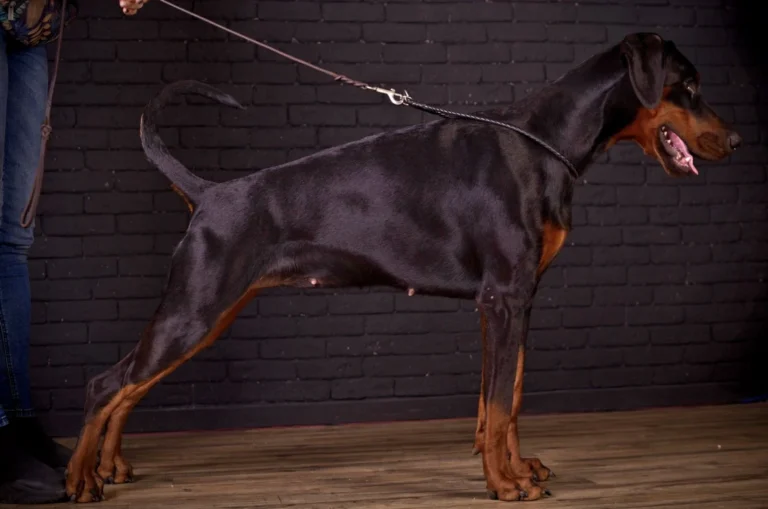
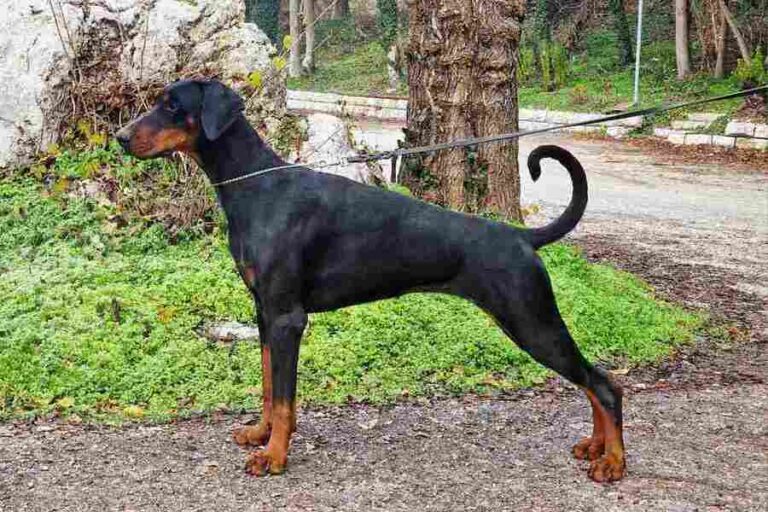
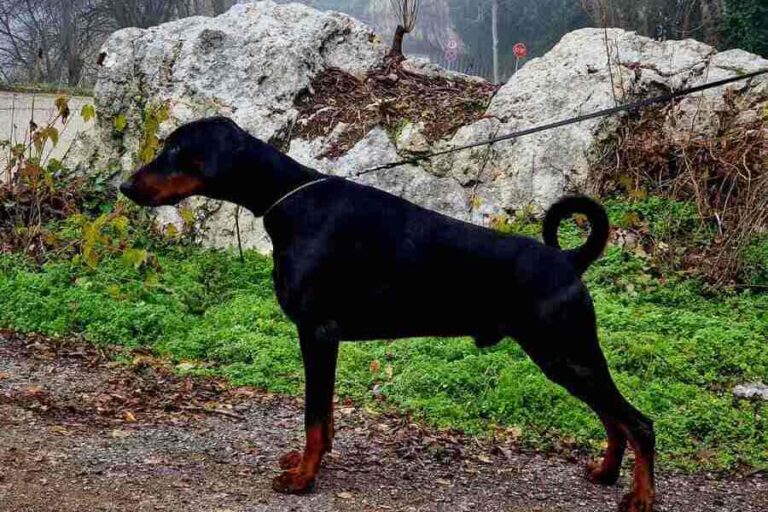
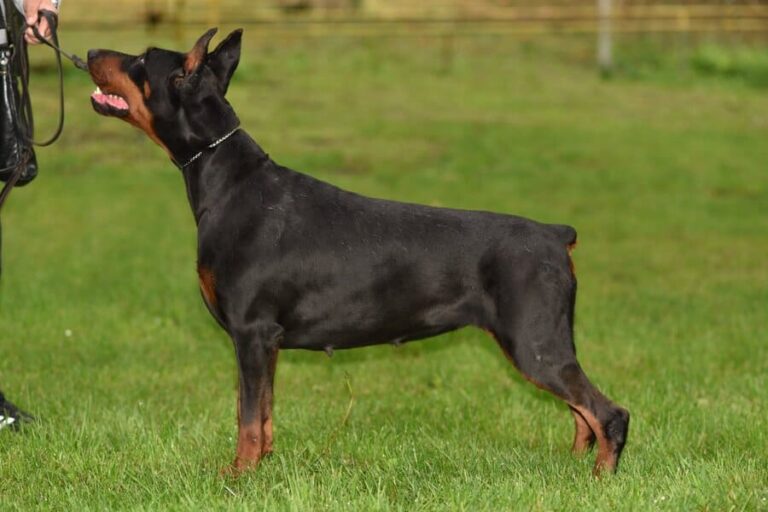
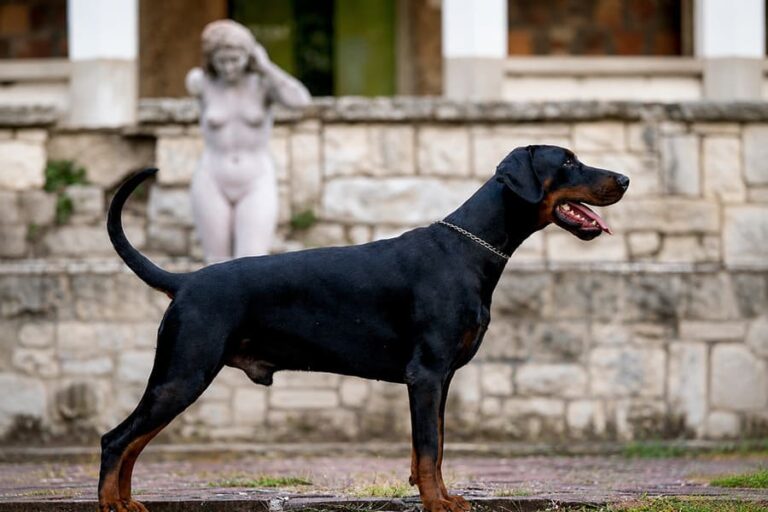
The Doberman should stand steadily and naturally. At shows, the stance is “free”—the dog holds the position on its own, without the handler supporting it with their hands. The front legs are parallel and perpendicular to the ground, the hind legs are slightly set back, and the head is held high. The stance should not appear forced. If the handler is constantly pulling, adjusting, or pressing the dog, this is immediately apparent.
According to FCI Standard No. 143, the Doberman should appear of medium size, strong and muscular, with elegant lines and a proud stance. The body is almost square—the length of the body should not exceed the height by more than 5% in males and 10% in females. These proportions must be clearly visible when the dog is standing.
Body control is developed gradually. The dog must understand that the "stay" command is a calm position, not a punishment. This is achieved through short holds, a clear command, and releasing the dog at the right moment.
It is a mistake to keep the dog in a standing position for too long, especially at the beginning. This causes the dog to get tired, sit down, fidget, or lose interest.
In a Doberman, a good stance should convey confidence. The head, alertness, and body line are important, but the dog’s natural demeanor should not be compromised.
The physical examination is a mandatory part of the evaluation. The dog must allow a stranger to examine it closely, touch it, and check specific anatomical features. If the dog consistently avoids the examination and does not allow inspection of its teeth, testicles, limbs, or tail, the FCI allows for a “Cannot Be Judged” rating.
Dogs enter the ring by class, gender, and catalog number. Usually, they first make a brief walk in a circle so the judge can assess their overall type, silhouette, rapport with the handler, and initial movement. The dog must walk in a controlled manner, without jumping, pulling, barking at other dogs, or attempting to leave the ring.
The judge evaluates the overall appearance, proportions, head, topline, chest, limbs, feet, rear angle, musculature, condition, and breed character.
The dog should stand steadily and calmly. Slight shifting is normal. Constant turning, sitting down, moving away from the judge, or stiffness interfere with the evaluation.
FCI Standard No. 143 requires a scissors bite, 42 teeth, correctly positioned and of normal size. An overshot, undershot, or level bite, as well as missing teeth, are disqualifying faults.
The handler demonstrates the bite by stabilizing the dog’s head, lifting the lips, and showing a front and side view—without using force. The judge may also request that the dog open its mouth fully to inspect all teeth.
The dog must allow the examination without flinching, panicking, spinning around, or trying to bite.
FCI Standard No. 143 requires that males have two visibly normal testicles, fully descended into the scrotum. The judge performs a brief tactile examination. Testicular abnormalities result in disqualification.
The dog must remain under control when touched. Pulling away forcefully, sitting down, turning away, growling, or attempting to bite are issues that must be addressed during training.
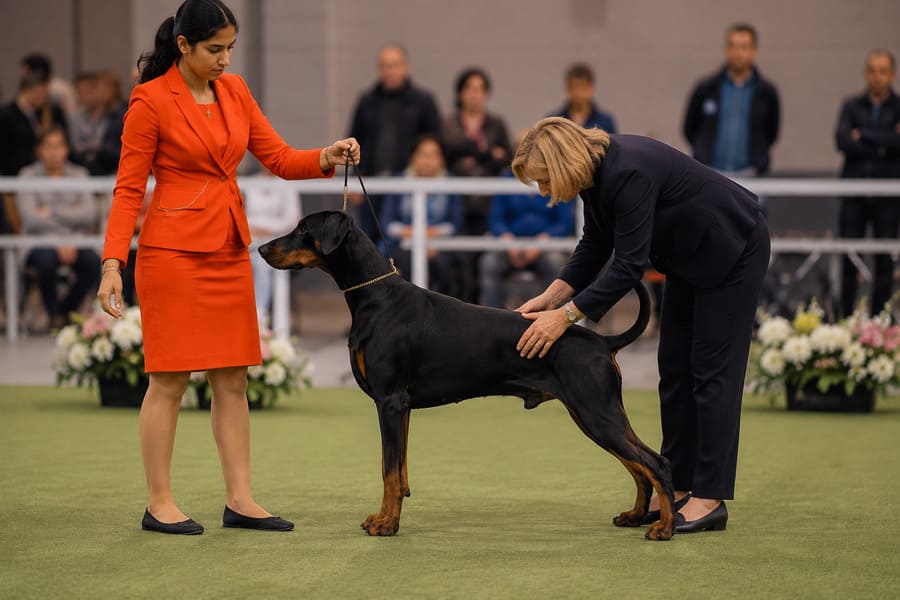
The judge may touch the head, neck, back, chest, shoulders, hindquarters, limbs, paws, and tail. In the Doberman, the standard values a sound structure, chest, correct angulation of the limbs, a short and strong back, a well-muscled loin, a slightly sloping croup, and a correct coat. A visible undercoat is a disqualifying fault.
The dog should react to being touched in a neutral manner—without cowering, guarding its body, growling, or trying to run away.
Movement is a key factor in the evaluation. When standing, the dog displays its conformation, but it is in motion that we see how the body functions.
According to FCI Standard No. 143, the Doberman’s gait should be elastic, elegant, agile, free, and covering ground. The front legs move forward, the hindquarters provide a springy thrust, and the back, ligaments, and joints are stable. Disharmonious movement is a fault. Pacing—the simultaneous movement of the limbs on one side—is explicitly listed as a fault in the standard.
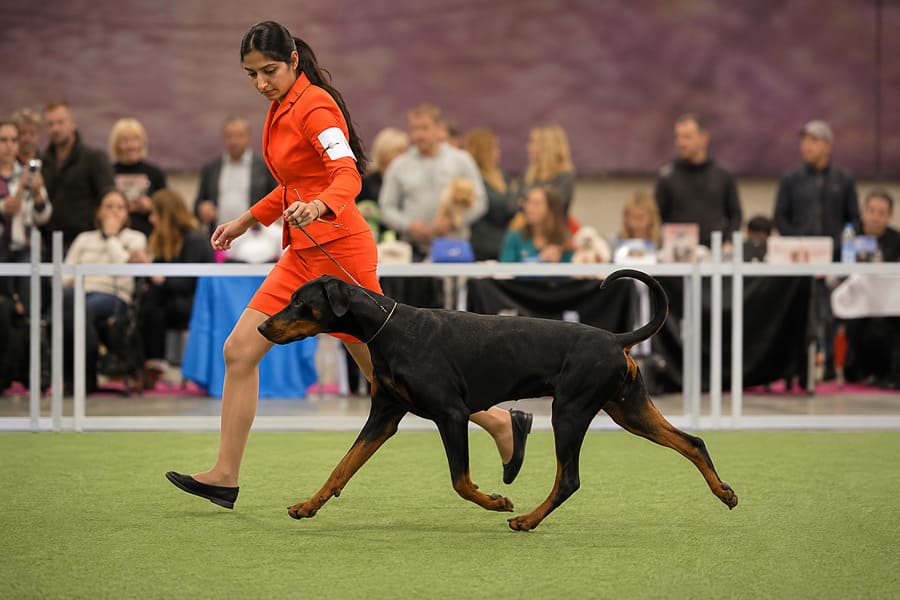
The handler should not drag the dog, hold it back too much, or let it jump around erratically. The pace should allow the dog to demonstrate its stride, line, and coordination.
The FCI does not specify a mandatory figure for each breed, but in practice the following are used:
Forward and backward movement – when the dog moves away, the judge observes its backward movement. When it returns, the judge observes its forward movement. The dog must move along the judge’s line of sight and return along the same line.
Триъгълник – дава 3 гледни точки последователно: задно движение, странично движение и предно движение. Фигурата не трябва да е прекалено широка или прекалено тясна.
Circle – used for lateral movement. It is usually moved counterclockwise so that the dog is on the judge’s side.
Group movement around the ring – demonstrates control, spacing, pace, and ring etiquette. The handler must not overtake, crowd other participants, or speed up to catch up with the dog in front.
L-shape and T-shape – are not mandated by the FCI as mandatory figures, but may be requested by a specific judge or used in national practice. Functionally, they combine a straight line and a lateral segment.
A poor ring performance can ruin the score even for a high-quality dog. The most common problems include: a pace that is too fast, causing the dog to break into a gallop; constant pulling on the leash; the handler blocking the dog from the judge’s view; a straight line that is crooked; and a triangle that is too narrow. In Dobermans, pacing is a specific fault according to the standard, and efforts must be made to correct it before a show.
A common mistake is for the handler to focus solely on the dog and forget about the ring. You must keep track of the distance to the other competitors, the direction, the pace, and the judge’s position.
In the ring, the bond between the dog and the handler is clearly visible. The Doberman is a breed that reacts strongly to the person beside it. If the handler is tense, disorganized, or unsure, this often rubs off on the dog.
Eye contact does not mean that the dog must constantly look the handler in the eyes. It means paying attention to cues, following directions, and staying focused even when distracted.
Baiting involves the handler using a stimulus—such as a treat or a toy—to hold the dog’s attention and achieve a free-standing position with an alert expression. The dog is focused, its ears are pricked, and its gaze is directed forward. Baiting is a legitimate and widely used technique with Dobermans.
A treat or a toy. A treat is a more manageable option for a beginner Doberman. Use a small, clean, non-crumbly piece. The goal is for the dog to focus and remain steady without lunging at your hand. A toy can provide stronger focus, but with Dobermans, it often increases excitement. If the dog starts jumping, barking, biting the leash, or losing its stance, the toy is getting in the way.
How to introduce it to a beginner dog. First, work outside the ring—brief contact with the hand, a calm stance. Then on a leash, without jumping toward the treat. Then in a distracting environment—other dogs, noise, people. In the ring, the treat is used briefly and discreetly, only for focus and expression. It should not be held constantly in front of the dog’s nose, because the dog will start to bend down, stretch its neck unnaturally, or shift its front legs.
When it's disruptive. It's disruptive when the dog jumps, barks, bites your hand, loses its composure, or distracts the other dogs. It's also disruptive if food or a toy falls on the ground.
Какво е забранено. Double handling – привличане на вниманието на кучето от човек, стоящ извън ринга – е забранен. FCI правилникът го определя като основание за „Cannot Be Judged“.
Preparing a Doberman for a show is not just about training in the ring. The dog’s overall appearance is of great importance.
The dog should be in good condition—neither underweight nor overweight. According to the standard, males weigh about 40–45 kg and females about 32–35 kg, but weight is not the only measure—what matters is the appearance of the musculature, the lines, and the movement. Excess weight hides the lines and impedes movement. A lack of musculature makes the dog look incomplete in appearance.
The Doberman’s coat is short, hard, dense, close-lying, and smooth, with no undercoat. A visible undercoat is a disqualifying fault according to the breed standard. The coat must appear clean, healthy, and well-groomed.
The teeth should be free of tartar. Untrimmed nails interfere with proper foot placement and are visible when the dog moves. The skin, eyes, and paws also contribute to the overall impression.
Color. According to the standard, the Doberman is black or brown with clearly defined rust-red markings. White markings are a disqualifying fault. Light or indistinct markings are a fault.
Before a show, you should not make any sudden changes to the dog’s diet, routine, or exercise regimen. The dog should enter the ring in its usual condition, not after last-minute experiments. Good physical condition is maintained through exercise, proper care, and a consistent routine.
A stressed dog in the ring doesn't always look aggressive or panicked. The signs are more subtle.
Конкретни поведенчески сигнали: прибрана опашка; уши наведени назад; ниска стойка на тялото; избягване на поглед; облизване на устни; прозяване без умора; учестено дишане без физическа причина; треперене; отдръпване от съдията; опит да напусне ринга; внезапно замръзване; ръмжене или защитна реакция при докосване.
According to FCI Standard No. 143, excessive shyness is a disqualifying fault—along with aggression. A dog that does not allow itself to be examined may receive a “Cannot Be Judged” rating.
The difference between stress, lack of preparation, and fatigue.
A stressed dog cowers, avoids the judge, tucks its tail, licks its lips, yawns, trembles, or reacts defensively. Fear is the driving factor.
An untrained dog doesn’t know what to do—it sits, spins around, pulls, doesn’t understand the “stay” command, and won’t let you touch its teeth, simply because it hasn’t been trained. It’s not fear; it’s a lack of experience.
A tired dog slows down, loses its posture, lets its back sag, sits down, moves heavily, and loses interest in the bait. But it does not show any fear of the judge.
What the handler can do at this moment. Release the tension on the leash. Do not punish the dog. Position yourself so that the dog can see you. Give a short, familiar command in a quiet voice. Use minimal biding. Ask for a second to reposition the dog, if the judge allows it. If the dog is highly stressed—do not force the examination of teeth or testicles and accept a lower score rather than worsen the dog’s behavior.
The requirements for a national show are determined by the organizer and the Bulgarian National Cynological Federation (BNCF). The BNCF is recognized by the FCI as a Contract Partner.
The following are being prepared:
To participate in the FCI-CACIB show, the dog must be entered in the show catalog. Dogs not listed in the catalog will not be judged. The entry form must be submitted by the deadline, and the entry fee must be paid.
There is a specific FCI requirement for Bulgarian dogs: according to FCI Circular 2/2024, only Bulgarian dogs with a Certified Export Pedigree issued by the Bulgarian Kennel Club (BNFK) are eligible for FCI-CACIB shows. Official FCI awards and titles are recognized only for dogs in possession of this document.
При пътуване в рамките на ЕС са нужни: ISO микрочип или допустима татуировка, EU паспорт за домашен любимец и валидна ваксинация против бяс. При първа ваксина против бяс животното трябва да е поне на 12 седмици и се изчакват минимум 21 дни преди пътуване.
When entering the EU from a non-EU country – an EU veterinary health certificate issued by an official state veterinarian no more than 10 days prior to arrival.
One of the most common mistakes is starting training too late. If the dog isn’t used to the leash, the standing position, the inspection, and the show ring environment, the show becomes a stressful situation.
Another mistake is overtraining in the final days. Long training sessions tire the dog out and make it nervous. It’s better to keep the sessions short, calm, and precise.
A third mistake is poor emotional control. A Doberman should be lively and active, but not uncontrollable. Excessive excitement, barking, pulling, and jumping hinder performance.
The fourth mistake is an inappropriate walking pace. If the handler walks too fast or keeps the dog moving too slowly, the movement cannot be seen properly.
The fifth mistake is unclear communication between the handler and the dog. In the ring, there is no time for lengthy explanations. Commands must be familiar, brief, and calm.
The sixth mistake is underestimating the dog’s overall appearance. A dog may have good qualities, but if it is in poor physical condition, with untrimmed nails, a shabby coat, or visible signs of fatigue, this affects the impression it makes.
The exhibition showcases not only the dog but also the work that goes into it. That is why preparing a Doberman for a show must be calm, consistent, and tailored to the individual dog.
When does exhibition preparation begin?
Preparation for dog shows begins at an early age, but gradually. First, we work on building trust, getting used to being touched, walking on a leash, maintaining short bursts of attention, and staying calm in new environments. More serious ring work is built upon according to the dog’s age and development. The first show participation is appropriate in the Minor Puppy (Baby) class at 4–6 months, solely for gaining experience.
Can any dog compete in a dog show?
A dog may be entered in a show if it meets the entry requirements and has the necessary documentation. Neutered dogs are not allowed in competitive classes at FCI shows. Dogs with disqualifying faults according to the standard—incorrect bite, missing teeth according to the formula, white markings, visible undercoat, height exceeding the standard by more than 2 cm, excessive shyness, or aggression—are given a "Disqualified" rating. If you are looking for a dog with show potential, check out our dogs for sale.
What does a judge look for in a Doberman?
The judge evaluates the Doberman according to FCI Standard No. 143—general appearance, proportions (nearly square), head, bite (scissor bite, 42 teeth), body, limbs, coat (without undercoat), color (black or brown with distinct tan markings), movement (elastic, ground-covering, without pacing), and temperament. In males, both testicles must be checked. Height is measured—the standard is 68–72 cm for males and 63–68 cm for females.
How long does the preparation take?
It depends on the dog’s age, temperament, and previous experience. Some dogs pick up the basics more quickly, while others need more time. The best results come from consistent, calm, and steady training, not from intensive last-minute training.
Do you need a special handler for a dog show?
It is not mandatory. The owner can handle the dog on their own if they have trained it sufficiently and are familiar with the ring rules. A professional handler has an advantage in terms of experience and technique, but a good dog will perform well even with a motivated owner. At smaller shows, having the owner handle the dog is the rule rather than the exception.
What documents are required to participate in an exhibition in Bulgaria?
For a national CAC show, the following are required: an entry form, a pedigree certificate, a passport, a microchip or tattoo, and valid vaccinations. When entering the Champion class, proof of a champion title is required. For the Working class – a valid WCC. For an international FCI-CACIB show, a Certified Export Pedigree issued by the BNFC is also mandatory for Bulgarian dogs.